What really differentiates a great VR simulation?

When an interaction doesn't behave as our brain expects, we notice — even subconsciously. Attention shifts away from the task and towards the simulation itself: "Why doesn't that feel quite right?" That moment of friction matters. It isn't the graphics. It isn't intricate sequencing or how much you can pack in. Often, it's something much simpler - whether it feels natural. At IkigaiXR, we combine 30+ years of real-world, in-field experience with 8 years of developing award-winning simulations to understand not just what an interaction should do, but how it should feel, and how to reproduce that digitally.

01

30+ Years Field Experience

Real-world, in-field expertise across high-hazard industries, not simulation built in isolation from practice.

02

8 Years Award-Winning Development

A dedicated track record designing simulations that have been recognised for excellence, not just delivered.

03

Behavioural Science-Led Methodology

Every interaction is designed around how the brain actually processes risk, attention, and automaticity.

It isn't binary.

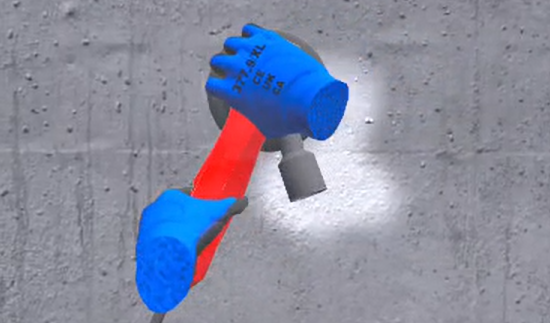
The same interaction can feel completely different depending on the environment and application. Take a grinder: free movement feels one way; once it’s operating, everything changes — the haptics, the sound, the resistance, the user’s safety instincts, their perception of risk. The digital-human interface needs to change with it.

In our early asset testing for the Bylor Joint Venture, the haptic feedback from the controller on a grinder isn’t a uniform vibration — we randomise the pattern to replicate the almost-unnoticed kicks you feel in real life when a grinder wheel hits a different density of concrete, or a divot. Not enough that you’d normally notice. But something, nonetheless.

It’s the little things that make the biggest difference.

Automaticity: the science behind "feels right"

Engagement and immersiveness are driven almost exclusively by the parts a learner never consciously notices. Psychologists call this automaticity — the auto-pilot state where everything outside the task at hand is assumed present and correct, so it can be largely ignored. Laser focus is reserved only for what’s unfamiliar.

Think of driving a car. We rarely think about how to drive — we’ve done it for years. It’s everything around us we focus on, because that’s where the brain knows there are unknowns: pedestrians, other drivers, a cat running into the road. We’re simply wired that way.

Recreating that same sense of the usual — so the learner’s brain accepts an interaction as natural and gets on with the task — is where the value sits in top-end simulation.

Strategic Advisor Profile: Dr. Peter Hughes

Dr. Peter Hughes is a renowned philosopher and psychologist. A celebrated TEDx speaker and TV consultant, Peter provides IkigaiXR with high-level oversight on the cognitive science of learning. We benefit from his extensive cognitive modelling work he specialises in at Cognition Agency where they apply sophisticated modelling techniques to understand how best to structure training programmes and maximise learning strategies, from individuals to global corporations

Peter's TedX

Want to know more?

Contact Us