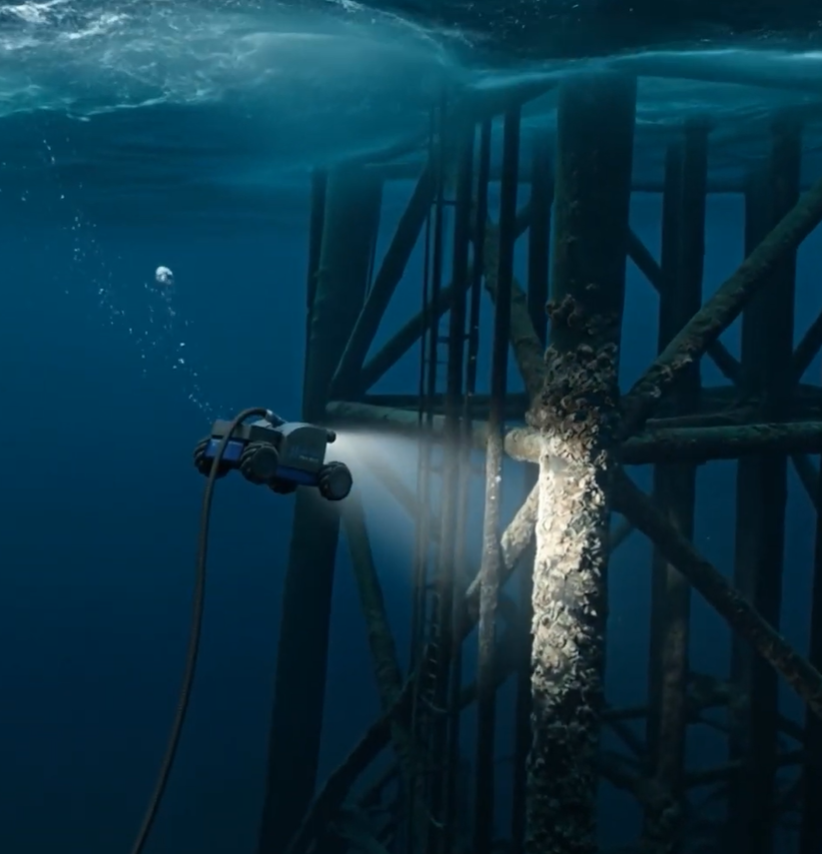
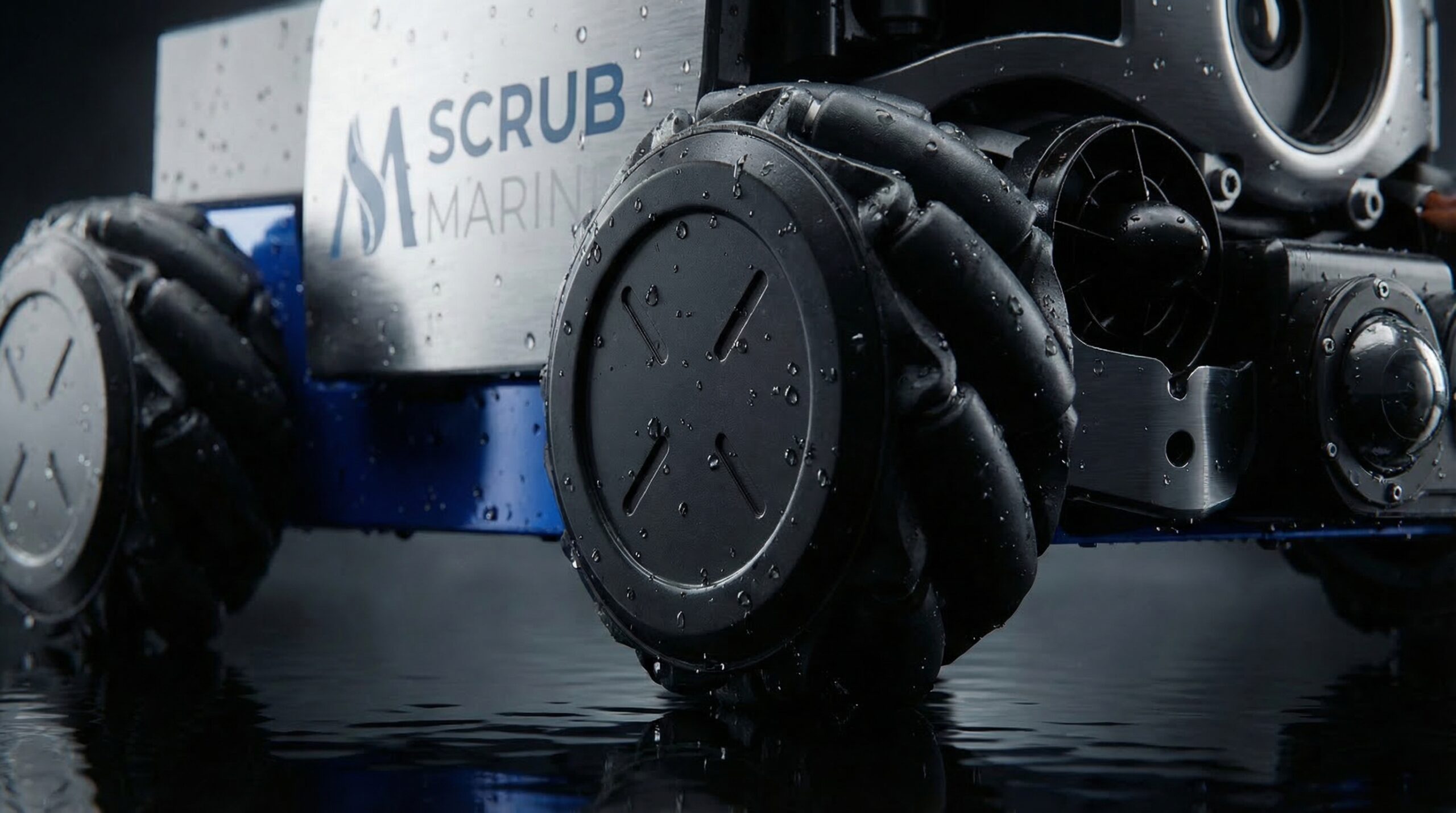
ScrubMarine started with a straightforward problem: fouled ship hulls waste fuel, and cleaning them is slow, costly, and often manual. Their autonomous robotic platform solved that. Then, based in Cumbria — a region whose economy has long leaned on a single industry — founders Rohith Devanathan and Clyne Albertelli took the platform somewhere bigger: full ocean-infrastructure scanning and inspection, opening ScrubMarine into markets far beyond where it started.
They’ve raised real investment to get here, and stayed lean and bootstrapped in how they run. What they hadn’t yet had was a way to show the world what they were building — a next-generation product still mid-development, with a conference stage in Texas booked to introduce it, and no visual identity yet that matched the scale of what they were attempting.
Our job was to stay in the background, work our magic and provide a solution that knocked it out of the park within a tight timeframe.
This is a project where our role was deliberately invisible. ScrubMarine’s technology, their ambition, and their moment on stage were always the point — our job was to make sure the film matched the scale of what they were building, not to make the film about us.
That’s the gap we exist to close for a company like this. A start-up with genuine, category-defining technology often can’t yet match that technology with a shop front that signals it — the kind of production value an Apple or Nike reveal carries as standard. We provided that: the tools, the technical depth, and a team that could deliver a premium, cinematic reveal for hardware that hadn’t yet reached production, so ScrubMarine could stand on that Texas stage looking exactly as far ahead as they actually are.
01
ScrubMarine, Cumbria — self-funded, investment-backed, and bootstrapped in how they operate
02
A premium technology-reveal film, launching their pivot from hull-cleaning to full infrastructure inspection
03
Introduced on a conference stage in Texas; built to remain their cornerstone marketing asset long after
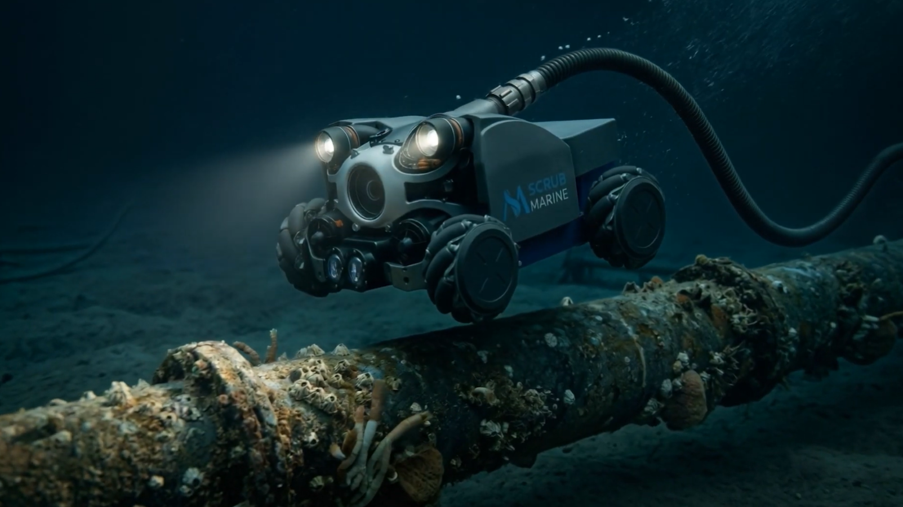
We built the film using AI-assisted video generation, VFX compositing, full 3D modelling, and Unreal Engine 5 – the same real-time engine capability behind our simulation work, here pointed at a cinematic outcome instead. It let us construct a technically convincing reveal of hardware still in development: clean modular attach and detach sequences, believable subsea environments, and a live-feeling software dashboard, all built before a finished physical unit existed to film.
The film’s structure carries ScrubMarine’s whole pivot in ninety seconds: the modular robotic platform, then a pull-back revealing a fleet operating at real infrastructure scale; autonomous deployment via their Whale vessel, moving from surface to subsea in a single smooth transition; the ScrubMarine Cloud dashboard turning a scan into a digital twin, a defect marker, and a maintenance recommendation; and a closing sweep across ships, offshore energy, wind, and ports – the same platform, working across every kind of ocean infrastructure ScrubMarine is built to serve.
Building something big?
VFX and Media Creation